
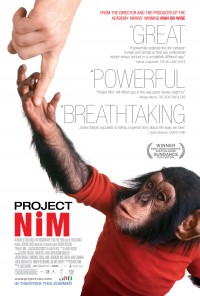
 Movie Review: Project Nim (2011), available on DVD and HBO

This true tale of a hippy-dippy “science” project run amok will leave you queasy. From the woman who breast feeds a baby chimp, to the research director who sleeps with his assistants, no one in the documentary Project Nim, which chronicles a 1970s experiment to see if a chimp can learn sign language and then follows him through various travails, seems capable of establishing boundaries. In fact, so many social and scientific lines are crossed that the value of the experiment is highly questionable, at best.
After the six-week-old Nim is heartrendingly separated from his mother, he’s raised in a home with seven kids and hippie parents who share their pot with Nim, don’t know sign language, and have no concept of what a scientific experiment should include, such as record keeping or schedules. Although the rambunctious Nim seems happy there, playing with the kids and pets, he takes an intense dislike to the father of the family, to the point of biting him. This is only the first wedge that Nim drives between the people involved in the experiment.
Reminiscent of , the film is really about the conflicts among the humans in Nim’s life and the resulting toll those disagreements take on the animal. Arguments arise over where and how he’s taught, where he should live, and who should control him and the experiment. As Nim starts to behave more and more like a wild chimp, the decision is made to remove him from the home to be raised by a young woman whom Dr. Herbert Terrace, the project director, has the hots for.
Director James Marsh skillfully elicits from his interviewees the emotional impact of the project, including an account from one young researcher whose affair with Dr. Terrace ends abruptly and painfully. Many tears are shed by all involved, except the stone-faced doctor, but Nim’s first human mother sums up the project’s effect on Nim most aptly: “We made a commitment to him and we failed. We did a disservice to that soul.”
As the chimp grows older, he gets more aggressive, including tearing open the side of a woman’s face, and Dr. Terrace finally realizes the experiment must end. Nim is shipped off to a creepy medical research facility and then to an animal sanctuary, but it’s not clear which place is worse.
provides a fascinating look at the antics of the anything-goes ’70s and serves as a stark reminder that when humans put their emotional needs first, helpless creatures often pay a very high price. If the tale of Nim’s Dickensian life doesn’t leave you teary-eyed, you’re not a worthy primate.
This review originally appeared in the bimonthly newspaper Happy Valley Animals.