
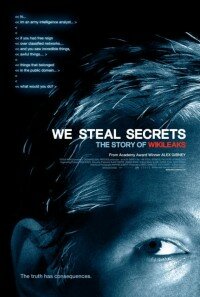
We Steal Secrets: The Story of WikiLeaks

We Steal Secrets: The Story Of WikileaksIf you’re looking for a Michael Moore style documentary where you know the good guys from the bad guys, then this movie is not for you. While the first fifteen minutes appeared to detail the heroism of Julian Assange against the misdeeds of the U.S. government, the following two hours depicted a far more complex reality in which people may do the right things for the wrong reasons, or the wrong things with laudable goals in mind. Director Alex Gibney doesn’t give us a Moore fable or an Oliver Stone lesson in propaganda, but rather a complex study of an Icarus-themed Assange and a tortured but saint-like Private Bradley Manning.

When Assange dumped thousands of documents about the U.S.’s handling of the Afghanistan war without redacting the names of the locals who worked with the U.S. government, Assange went from hero to arrogant bastard. For him it was more important to get the word out regardless of whom it hurt or killed. Admittedly, Assange’s WikiLeaks turns out to be more a one-man organization than a dedicated band of Robin Hoods who steal from the U.S. government to give to the world. Did Assange care that people might die to facilitate the better free flow of information, or was he simply unable to redact the affected peoples names with a lack of staff and approaching deadlines for the release of information? We may never know.

As we delve into the personalities of Assange, and Private Manning who illegally downloaded hundreds of thousand of documents from the U.S. government, we find that both men are damaged goods. Assange was an unloved child whose mother divorced several times and who was shunted around more than thirty residences in Australia. Manning was a small, slightly effeminate gay who was bullied in school and not sure of his gender. From a divorced family with an alcoholic mother, he also felt himself very much alone. Whatever their environment and resultant personality failures, both were computer geniuses.

But overarching questions remain. When can the most powerful government in the world keep information hidden, and when must it release it? Is the embarrassment of inadvertently killing journalists in Iraq enough of a reason? Is potentially outing collaborators sufficient, and who decides and why and how?

In the Army, you’re supposed to follow orders, not your conscience. So, for Private Manning, it was a three-fer, not only was he a lonely homosexual with a stronger conscience because of what he had experienced, but he also felt that he was a woman trapped in a man’s body – and he had no one to turn to for help. The only surprise was how long it took him to unravel or to grow a pair – it all depends on your point of view.

So, if there is a hero in this mess, it’s probably not Julian Assange, whose dark side was more fitted to playing Darth Vader than Han Solo. Two damaged boys grow up to be damaged young men who want to get even with society, or, from a rosier point of view, men who want to change society and the U.S. government into something it isn’t. Beware of what you wish for: The consequences may be more severe than you imagined.

Oliver Stone’s Revisionist History

The New York Film Festival hosted the first three hours of Oliver Stone’s self-described “revisionist history” of World War II through the present, soon to be shown on Showtime. Those three episodes of Stone’s “Untold History of the United States” concerned World War II and its immediate aftermath.

Director Stone, known for his leftist views and conspiracy theories, and his associate Peter Kuznick discussed their work and fielded questions. First, I would note that Stone gave a surprisingly complex view of this history. Secondly, where he tried to be provocative, I think he was many times wrong.

His hero of World War II is Vice President Henry Wallace, one of the elite class that Stone usually despises. His villain is the man of the people President Harry Truman.

Stone believes that if progressive Henry Wallace had been nominated as Vice President in 1944, the outcome of modern history would have been different. In spite of his evident popularity with the common people and the unions, the Democratic Party bosses connived to get anybody but Wallace nominated. According to our director, they stooped so low that they eventually decided on know nothing Harry Truman, a man who could be easily manipulated. After his successful nomination and election, Truman only had to wait about three months to become President. During his wait, he only saw the President twice and didn’t even know about the Manhattan Project to build the atomic bomb.

According to Stone, Truman was at best a naïf, at worst a stooge of the Party bosses. Stone considers him, like many of his contemporaries, a small town racist whose major talent was failing at business several times and who got into politics so one party boss could show that he could get anyone elected, even Truman. While Stone tells us of Truman’s bankruptcy at a haberdashery, he doesn’t mention that Truman and his partner spent the next several years repaying all the money they owed, for that might show Truman in a different light. Stone detests Truman for not stopping the use of the atomic bomb on Hiroshima and Nagasaki. Stone said that the Soviet Union’s entry into the war against Japan obviated the need to bomb. While the vast majority of Americans back then believed it was a necessary evil to prevent from hundreds of thousands to more than a million casualties if the US had to invade the main Japanese islands, Stone knows the Japanese would have surrendered anyway, in spite of an attempted coup by junior officers, which Stone downplays. We all know that “junior” officers never succeed in coups, but don’t tell that to the Third world.

Stone doesn’t like the fact that Japan was told to surrender unconditionally, but partially because of that, Japan hasn’t been a military power for almost 70 years. Neither has Germany nor Italy for that matter.

Stone does show that German racism against the Japanese prevented the former from informing their ally of major decisions, thus helping to end the war earlier, and that American racism against the West Coast Japanese forced them into camps for the duration of the war. The American and allied bombing against the enemies’ civilian populations after Germany and Japan showed the allies how to do it, is surely a low point in a series of low moral points of each side. However, the systematic extermination, rape and torture by the Axis powers do not get the play they deserve. The Americans and their allies were sometimes beastly, but the Axis powers were positively subhuman. Just ask the six million Jews of Europe. Oh, I’m sorry, you can’t. Well maybe you could ask the Gypsies, homosexuals, three million Poles or twenty million Russians. Perhaps the only one on a par with the Germans was Stalin.

But what if patrician Henry Wallace had managed to get the Democratic VP nomination in 1944? Stone believes that anti-war and pro civil rights Wallace would have allowed Japan to surrender with conditions, would have prevented the atomic bomb from being used, would have stopped the arms race and would have integrated the country. I think that, had Wallace been President, the party bosses, the Republican party and the right, including Hoover, McCarthy and many others would have hounded him from the day he took office. Think of what Obama has had to experience and multiply that tenfold. His progressive tendencies would have been blocked by a more conservative congress, and his life would have been a living hell. At best, he probably would have been impeached. There is no way he would have been more than a one term President.

Regarding “naïf” or “stooge” Harry Truman, he integrated the armed forces, started the post-war reconstruction, founded NATO (a negative to the left), and recognized Israel, which the far-left love to compare with Nazi Germany. Sometimes you have to be a Nixon to go to China. Regarding Israel, it certainly wasn’t the Party bosses or the genteelly anti-Semitic elite or the State Department who wanted Israel to exist. Politically, it wasn’t a smart decision, but perhaps it was a moral one.

Stone and Kuznick are to be commended for their extensive research, but they would have done better with a little less revisionary provocation and a little more attention to the greater forces that determine our world.

Posted in Film, History, Politics | Tagged Democrats, Harry Truman, Henry Wallace, New York Film Festival, , Peter Kuznick, , Untold History of the United States, World War II | Leave a reply