The Power of Transformation: My Day in the Movies

TransformationUsing Craigslist, my wife and I volunteered to be extras on a movie filming in the New York City area. We submitted a photo and our measurements. We both expected to play tourists visiting a restored nineteenth century village that uses costumed re-enactors. While she did portray a tourist, my fate was different.

We arrived on set at about 11:30 am and signed in with a bubbly young woman who was coordinating the extras. She told us she would try to have us in and out expeditiously. Of course, we waited and waited. We had been told there would be air conditioning, but as the outside temperature approached 100, all we had was two medium-sized electric fans for at least one hundred extras. We therefore decided to go out on the terrace, where the temperature felt at least ten degrees cooler. I had an inkling that something was about to change, when the extra wrangler approached us and told us to come inside and sit near her. She then told me I looked like “The Mayor.”

The wardrobe mistress fetched me and took me to a room where I had two choices of nineteenth-century-style wool jackets whose sleeves were a little long on me, one top hat that mysteriously fit perfectly, and a black cravat. She then sent me back to the hot-box holding room.

A half hour later she came for me again, gave me my clothes, and told me to put them on. A half hour after that, the make-up woman did my face. I was now officially “The Mayor,” clad in three layers of clothing, trying to adjust to the heat. Then I was on call for what turned out to be the next five hours.

Putting on the costume metamorphosed my shy self into an outgoing, talkative personality. When I looked in the mirror, I appeared a little like Abraham Lincoln. The staff started calling me “Mr. Mayor.”  Other extras asked me to pose for pictures with them. One star-struck guy wanted to know what other movies I had been in. A little girl kept giving tea and lemonade to “The Mayor.” Another extra who had brought his own outfit looked like Stan Laurel of the Laurel and Hardy comedy team of the first half of the twentieth century. He was a voice impersonator with a spot-on Bullwinkle and Yoda, and said he had been in more than 100 movies. The SAG-AFTRA actors, normally aloof from the non-union extras, treated me like one of them, sharing their stories with me. One sweet looking young woman had been an international karate champion and had qualified for the Olympics.

Finally, at about 6 pm, those in period costumes took a van to the outdoor area where filming was taking place. Everybody seemed to know my character, including the co-director and her assistants. I was “The Mayor.” I had my picture taken by an official set photographer and by an assistant director. My actual part was fairly small. I was to wave, tip my hat, and greet visitors entering and leaving the park. While I assumed we were filming a comedy, I actually have no idea if my assumption was accurate. When the two stars passed by me, one of them started exaggeratedly bowing to me, which I returned in kind. Through the five takes, it became a game between us.

As we were returning to holding, all the extras, including my wife, were told they could go, except for those dressed in period costumes. The staff at holding hadn’t gotten the message, however, and some told us we could leave as well. I had to inform them we were asked to wait. Finally around 8 pm as the sun was starting to set, all of us, including my wife who had to stay because of me, were summoned back to the set for the last scene to be shot at the park.  My job was similar to the first scene, except I was to thank people for visiting. Because of the lack of time almost no one was able to exit and I would be surprised if I were in frame in the scene.

In most movies the stars are off limits to the extras. You’re not supposed to talk with them or have any contact with them, including eye contact. This time was different. The two stars, who are household names, graciously allowed their pictures to be taken with some of the extras. As “The Mayor,” I was allowed to cut in line to do so with one of them.

I didn’t want to give back my costume, as it had somehow made me other than I was. I had been magically transmuted into a different person and energized. All in all, it was a pleasure for this usually skeptical observer of life, who is now smitten with the acting bug. In this one area, my wife is now more skeptical than I am about looking for more jobs as extras.


Model Christy Turlington Burns Says Childbirth Deaths Are Avoidable

Christy Turlington BurnsShe’s on the cover of the June/July 2013 issue of Harper’s Bazaar. She’s one of Fast Company’s most creative people of 2013. And she’s determined to stop women from dying in childbirth.

Every day, roughly one thousand women die from the complications of pregnancy or childbirth, yet most of these deaths are preventable. That’s the message of model and activist Christy Turlington Burns’ documentary “No Woman, No Cry.”

The first-time filmmaker’s own experience with post-partum hemorrhaging after the birth of her daughter, Grace, and a 2005 visit to El Salvador, her mother’s homeland, inspired Turlington Burns to document maternal mortality worldwide.

“It’s a global tragedy,” she said at a screening of the film in New York City, so she decided to tell the stories of women in four different countries.

Turlington Burns first takes us to Tanzania, where a very pregnant Janet must walk five miles to reach a small clinic. She has no food with her, and the clinic provides none. Because her labor has not progressed enough, the health care worker sends her home. When Janet returns to the clinic, she’s so weak that she’s told she must now get to a hospital, a one-hour drive away. The van to take her costs $30, more than one month’s income for Janet’s family. Turlington Burns provides the money, and Janet gives birth to a healthy boy.

Tanzania lacks adequate health care facilities and medical personnel, as do most developing nations, with only one obstetrician for every 2.5 million people. With more and better facilities, women like Janet don’t need to die, as she surely would have if the film crew had not been there.

In Bangladesh, the issues are different. Health care facilities are often close by, yet most women will not use them because of the social stigma attached: it’s considered shameful to give birth outside the home. With proper education, however, attitudes can change. When a health care worker counsels Monica, who is ashamed to seek medical help, she finally agrees to have her baby in a hospital, leading to a happy outcome – the birth of a son.

In Guatemala, Turlington Burns encounters yet another issue. Abortion is illegal, even in cases of rape and incest. So when a young woman becomes pregnant as a result of rape, her illegal abortion almost kills her; it takes nearly six weeks of hospitalization for her to recover. Changing religiously based norms is probably the toughest challenge regarding maternal health, but it can happen, Turlington Burns argues.

Although 99 percent of childbirth-related deaths occur in the developing world, the United States has vast room for improvement, ranking 50th in maternal mortality. Women of color are especially vulnerable, as are those who have no health insurance.

“Being uninsured and pregnant is a disaster,” said Jennie Joseph, a Florida midwife featured in the film.

Ironically, the only woman who dies of childbirth-related complications in the documentary is an American woman who succumbs to an amniotic fluid aneurism. Turlington Burns shows the toll her death takes on her family with sensitivity and compassion.

Two years in the making, “” can be purchased on iTunes and Amazon.

The Jerusalem Post Conference and Caroline Glick

Caroline GlickThe second annual Jerusalem Post Conference, subtitled Fighting for the Zionist Dream, was held in New York City rather than Jerusalem – probably to attract the widest possible audience of supporters of Zionism and Israel.

The highlight of the conference was the speech and later panel appearance by the polarizing senior contributing editor of the Jerusalem Post and editor of Latma, Caroline Glick.

Latma, which is similar in concept to Jon Stewart’s The Daily Show except with satirical songs thrown in, depicts two leftist and clueless television reporters editorializing on the current Israel-related news. Cutting through all the propaganda surrounding events, such as the Mavi Marmara flotilla, the songs can be devastatingly funny and spot-on accurate. The flotilla song We Con the World (sung to the tune of We are the World) drew millions of hits and was worth more to the Israeli side than any hasbara, as it countered the exasperated horror routinely expected from the Arab world and the EU. To say that Ms. Glick is an Israeli national treasure would be an understatement.

Born into a middle-class Jewish home in Chicago, she was raised in a traditional left-leaning liberal environment. After making aliyah to Israel, she claimed to have come to understand realpolitik. To her, leftists are fools who wish for a world that doesn’t and will never exist. For example, the fact that Israelis, Americans, and the European countries want there to be peace in the Middle East and want there to be a two-state solution for Israel and the Palestinians, doesn’t mean that the Palestinians or the Arab world wants the same. She believes that the Palestinians will never give up the idea of the destruction of Israel and at best will yield to a two-stage solution in which the Jewish state is first stripped of defensible borders and is then attacked with missiles and bombs until it is defeated, whether it takes decades or centuries. She has a long-term strategist’s view of the Middle East that is not pleasant, but certainly devastating.

Thus, when she speaks even to a pro-Israel audience, she can be condescending, and when she replies to other speakers, she can be dripping with sarcasm and animus. She is like an elementary school teacher who must tell a clueless kindergartner over and over again not to place his wet hand over an electrical outlet. Like the greater public, the student never quite gets the danger even if he is shocked over and over.

Like Snidely Whiplash, the evil enemy of Dudley Do-Right in Rocky and Bullwinkle Show, she curled her lip in a snarl that said it all. Except in this version, she was the hero and Dudley was a dud who didn’t know what he was doing. She is brilliant, incisive, cutting and just a shade paranoid. But in the world she lives in, paranoia can be life saving.

So is she the wunderkind of Israeli politics or just the enfant terrible? Maybe she is just an acerbic Daniel Patrick Moynihan, who, against the wishes of his superiors, railed at the UN against the passing of the Zionism is Racism resolution in 1975. I believe she is a brilliant person – with a blind spot. That is, she doesn’t see that we Americans do see what an impossible and unfair situation Israel is in. Where anything Jews do is biased and under-handed, whereas whatever their opponents do is above-board and laudable. Where suicide bombing and indiscriminate rockets are simply tools of resistance, but Israeli defense is a war crime. Where an American Jew is accused of dual loyalty if he supports Israel, but an Irish American is just supporting his heritage when he supports Ireland. Where 12 million Jews are said to control the world, while a billion Moslems are helpless and a billion Christians wring their hands in silence. In such a world, it is not surprising that Caroline Glick is angry and frustrated. It is only surprising that more of us citizens of the world are not.

Glick does not think too highly of Americans. When she started her presentation, she stated that she would much rather speak on another topic, but that we Americans needed to hear her. She said that the purpose of the BDS (boycotts, divestment and sanctions) movement was the destruction of the state of Israel, not just the elimination of Israel from the West Bank. She asked why Jews are inviting anti-Semites, including former President Carter and BDS members to speak at Jewish forums? Are we fools and dupes?

After the 1973 Israeli–Arab war in which Israel conquered the West Bank, part of Jerusalem, and the Golan Heights, the international left abandoned Israel. Leftist Jews now join with Israel’s enemies to destroy it, while stating how courageous they are. But Israel and American Jews need each other, and might not survive without each other. There is an unwillingness to call things by their names. These are uncomfortable truths. Glick is very angry but still hopeful.

My problem with Caroline Glick is that I think the majority of Americans, including a majority of Jews, do understand Israeli-Arab problems and the unremitting prejudice against Israel from the Arab world, many EU countries, and especially the UN. I see a perceptible turning to Israel even among the twenty-somethings who are traditionally more to the left of the political spectrum. , the contemporary news site of the young, has gotten consistently more pro-Israel in its reader comments.  Several years ago, the majority of the readers’ comments were anti-Israel; today, the majority are either pro-Israel or at least understanding of its positions. In fact, I see that Israel today is in a far stronger position than its friends think and its enemies desire.

My Name is Asher Lev – As Close to Greatness as Any On or Off Broadway Play is Likely to Get

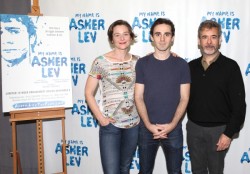
My Name is Asher Lev, playing at the Westside Theater in New York City, is about as close to greatness as any on or off-Broadway play is likely to get. Ninety-five minutes of mesmerizing acting led me to remember what a play is capable of. Although My Name is Asher Lev appears to be about a young Hasidic man’s desire to find himself in a community that doesn’t understand who he is, it is actually a universal story of a young man, perhaps a Jewish version of James Joyce’s The Portrait of the Artist as a Young Man. It is a coming of age story, a struggle against the father he loves but must disobey, love for his intercessor mother who positions herself between two warriors, and his finding himself in a sometimes hostile world.

Specifically, it is the story of a “Torah-believing” Jew who has a hunger to paint in a community that believes art is a foolish waste of time.

With Ari Brand playing the lead, we don’t just observe his struggle, we feel it. We agonize over his love for his parents, his need to separate from and yet still be a part of them, and his desire to be an observant Jew in a gentile world.

Jenny Bacon, who portrays several different women, as Rivkeh Lev is so strong as the mother that when she also portrays the artist’s model, it feels a little incestuous. When she is about to disrobe so Asher can draw her, I was so invested in Asher that I was thinking, “Keep your robe on. It isn’t right to view your nakedness.” And Bacon’s portrayal of the gallery owner is so far removed from her other two roles that she seems a different actress.

Mark Nelson as Aryeh Lev is profound as the father struggling with love and duty to his rabbi and his son. Nelson’s portrayal of Asher’s painting tutor, Jacob Kahn, seems to embody the position that Asher’s father would love to embrace but can’t.

Rather ironically, Asher’s name in Hebrew means “happy.” In the Torah, he was a son of Joseph by a handmaiden, implying that Asher isn’t quite kosher. Some scholars suggest the tribe of Asher was descended from the Sea Peoples, one of whom were the Philistines. Rivka means “to bind,” and she is the one who keeps the family together. The father’s name, Aryeh, means “lion”, and he is a fierce protector and leader of his Hasidic community. As for the tutor’s name, Jacob was the one who struggled with an angel, and Kahn means “priest”, perhaps of the religion of art.

One of the great strengths of the production is that it gets you to feel it from the perspective of its characters. Few plays today do that. And unlike so many other current plays, like Grace, whose lead character is shallowly portrayed as a religious maniac, My Name is Asher Lev doesn’t belittle its characters.

In spite of the lead character’s continual struggle, this is a very hopeful play. This powerful portrait of an artist’s struggle inspired me to emulate Asher’s desire to become who he is really is.

Posted in Review, Theatre | Tagged Ari Brand, Aryeh Lev, Asher Lev, , coming of age, Grace, Hasidic, Jacob Kahn, James Joyce, Jenny Bacon, , Mark Nelson, My Name is Asher Lev, , Rivkeh Lev, The Portrait of the Artist as a Young Man, Torah, Westside Theater | Leave a reply