
Lawyer Creates Story of Animals, Angst and the Afterlife

Unsaid: A Novel by Neil Abramson
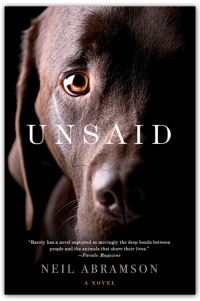
Unsaid: A Novel
A husband laments the death of his wife; the deceased wife watches him suffer. Ugh. Just shoot me now. But really, it’s not as depressing as it sounds. In fact, it’s not depressing at all.

Unsaid tells a remarkable story of betrayal, forgiveness, animals, humans, and a variety of relationships, all seen through the eyes of a dead woman. The narrator, Helena, was a veterinarian and animal researcher until her early demise from cancer. Now, from some non-earthly realm, she observes those she left behind.

Her husband, David, a lawyer, torn apart by her death, must make peace with the animals she loved, as well as the secret parts of her life he discovers by chance. Unbeknownst to him, Helena had helped a colleague study whether or not a chimp can be taught to communicate using sign language. When the chimp’s life is endangered and crimes are committed, David is dragged into the situation, forcing him to make difficult choices and to come to terms with the truth about the woman he thought he knew so well.

The author, Neil Abramson, a lawyer married to a veterinarian, has created a cast of characters it’s easy to care about, including chimps, pigs, horses, dogs and cats. And even if you don’t think there’s any form of life after death, Abramson’s straightforward style makes a story narrated by a dead woman somehow feel believable, especially as Helena watches her husband struggle with the animals that were once her beloved companions.

In the face of [the horse] Arthur’s obstinacy, David starts tugging on the halter, cursing under his breath. Arthur doesn’t welcome my husband’s hostility. While David still holds the halter, Arthur whips his head around, sending David tumbling into the nearby hay bales.

When David rises unsteadily from the barn floor, he reminds me of Ray Bolger in The Wizard of Oz. His knee joints wobble and hay sticks out of his hair, topcoat, pant legs, and even his socks and shoes. When he walks, hay drops out of his pants as if the hay somehow has become his very essence.

Although a dead woman tells the story, is very much a tale about life, both how and how not to live it. Perhaps the true heart of the book is the nugget of wisdom conveyed to David by an old friend of his wife: Pessimism, cynicism and fear will only lead to a very small life. Don’t live small.

This review originally appeared in the bimonthly newspaper Happy Valley Animals.

Project Nim (2011) – Thoughtless Experiment Takes a Toll on Chimp and Humans

Project NimMovie Review: Project Nim (2011), available on DVD and HBO

This true tale of a hippy-dippy “science” project run amok will leave you queasy. From the woman who breast feeds a baby chimp, to the research director who sleeps with his assistants, no one in the documentary Project Nim, which chronicles a 1970s experiment to see if a chimp can learn sign language and then follows him through various travails, seems capable of establishing boundaries. In fact, so many social and scientific lines are crossed that the value of the experiment is highly questionable, at best.

After the six-week-old Nim is heartrendingly separated from his mother, he’s raised in a home with seven kids and hippie parents who share their pot with Nim, don’t know sign language, and have no concept of what a scientific experiment should include, such as record keeping or schedules. Although the rambunctious Nim seems happy there, playing with the kids and pets, he takes an intense dislike to the father of the family, to the point of biting him. This is only the first wedge that Nim drives between the people involved in the experiment.

Reminiscent of , the film is really about the conflicts among the humans in Nim’s life and the resulting toll those disagreements take on the animal. Arguments arise over where and how he’s taught, where he should live, and who should control him and the experiment. As Nim starts to behave more and more like a wild chimp, the decision is made to remove him from the home to be raised by a young woman whom Dr. Herbert Terrace, the project director, has the hots for.

Director James Marsh skillfully elicits from his interviewees the emotional impact of the project, including an account from one young researcher whose affair with Dr. Terrace ends abruptly and painfully. Many tears are shed by all involved, except the stone-faced doctor, but Nim’s first human mother sums up the project’s effect on Nim most aptly: “We made a commitment to him and we failed. We did a disservice to that soul.”

As the chimp grows older, he gets more aggressive, including tearing open the side of a woman’s face, and Dr. Terrace finally realizes the experiment must end. Nim is shipped off to a creepy medical research facility and then to an animal sanctuary, but it’s not clear which place is worse.

provides a fascinating look at the antics of the anything-goes ’70s and serves as a stark reminder that when humans put their emotional needs first, helpless creatures often pay a very high price. If the tale of Nim’s Dickensian life doesn’t leave you teary-eyed, you’re not a worthy primate.

This review originally appeared in the bimonthly newspaper Happy Valley Animals.