

We Steal Secrets: The Story of WikiLeaks

We Steal Secrets: The Story Of WikileaksIf you’re looking for a Michael Moore style documentary where you know the good guys from the bad guys, then this movie is not for you. While the first fifteen minutes appeared to detail the heroism of Julian Assange against the misdeeds of the U.S. government, the following two hours depicted a far more complex reality in which people may do the right things for the wrong reasons, or the wrong things with laudable goals in mind. Director Alex Gibney doesn’t give us a Moore fable or an Oliver Stone lesson in propaganda, but rather a complex study of an Icarus-themed Assange and a tortured but saint-like Private Bradley Manning.

When Assange dumped thousands of documents about the U.S.’s handling of the Afghanistan war without redacting the names of the locals who worked with the U.S. government, Assange went from hero to arrogant bastard. For him it was more important to get the word out regardless of whom it hurt or killed. Admittedly, Assange’s WikiLeaks turns out to be more a one-man organization than a dedicated band of Robin Hoods who steal from the U.S. government to give to the world. Did Assange care that people might die to facilitate the better free flow of information, or was he simply unable to redact the affected peoples names with a lack of staff and approaching deadlines for the release of information? We may never know.

As we delve into the personalities of Assange, and Private Manning who illegally downloaded hundreds of thousand of documents from the U.S. government, we find that both men are damaged goods. Assange was an unloved child whose mother divorced several times and who was shunted around more than thirty residences in Australia. Manning was a small, slightly effeminate gay who was bullied in school and not sure of his gender. From a divorced family with an alcoholic mother, he also felt himself very much alone. Whatever their environment and resultant personality failures, both were computer geniuses.

But overarching questions remain. When can the most powerful government in the world keep information hidden, and when must it release it? Is the embarrassment of inadvertently killing journalists in Iraq enough of a reason? Is potentially outing collaborators sufficient, and who decides and why and how?

In the Army, you’re supposed to follow orders, not your conscience. So, for Private Manning, it was a three-fer, not only was he a lonely homosexual with a stronger conscience because of what he had experienced, but he also felt that he was a woman trapped in a man’s body – and he had no one to turn to for help. The only surprise was how long it took him to unravel or to grow a pair – it all depends on your point of view.

So, if there is a hero in this mess, it’s probably not Julian Assange, whose dark side was more fitted to playing Darth Vader than Han Solo. Two damaged boys grow up to be damaged young men who want to get even with society, or, from a rosier point of view, men who want to change society and the U.S. government into something it isn’t. Beware of what you wish for: The consequences may be more severe than you imagined.


The Jerusalem Post Conference and Caroline Glick

Caroline GlickThe second annual Jerusalem Post Conference, subtitled Fighting for the Zionist Dream, was held in New York City rather than Jerusalem – probably to attract the widest possible audience of supporters of Zionism and Israel.

The highlight of the conference was the speech and later panel appearance by the polarizing senior contributing editor of the Jerusalem Post and editor of Latma, Caroline Glick.

Latma, which is similar in concept to Jon Stewart’s The Daily Show except with satirical songs thrown in, depicts two leftist and clueless television reporters editorializing on the current Israel-related news. Cutting through all the propaganda surrounding events, such as the Mavi Marmara flotilla, the songs can be devastatingly funny and spot-on accurate. The flotilla song We Con the World (sung to the tune of We are the World) drew millions of hits and was worth more to the Israeli side than any hasbara, as it countered the exasperated horror routinely expected from the Arab world and the EU. To say that Ms. Glick is an Israeli national treasure would be an understatement.

Born into a middle-class Jewish home in Chicago, she was raised in a traditional left-leaning liberal environment. After making aliyah to Israel, she claimed to have come to understand realpolitik. To her, leftists are fools who wish for a world that doesn’t and will never exist. For example, the fact that Israelis, Americans, and the European countries want there to be peace in the Middle East and want there to be a two-state solution for Israel and the Palestinians, doesn’t mean that the Palestinians or the Arab world wants the same. She believes that the Palestinians will never give up the idea of the destruction of Israel and at best will yield to a two-stage solution in which the Jewish state is first stripped of defensible borders and is then attacked with missiles and bombs until it is defeated, whether it takes decades or centuries. She has a long-term strategist’s view of the Middle East that is not pleasant, but certainly devastating.

Thus, when she speaks even to a pro-Israel audience, she can be condescending, and when she replies to other speakers, she can be dripping with sarcasm and animus. She is like an elementary school teacher who must tell a clueless kindergartner over and over again not to place his wet hand over an electrical outlet. Like the greater public, the student never quite gets the danger even if he is shocked over and over.

Like Snidely Whiplash, the evil enemy of Dudley Do-Right in Rocky and Bullwinkle Show, she curled her lip in a snarl that said it all. Except in this version, she was the hero and Dudley was a dud who didn’t know what he was doing. She is brilliant, incisive, cutting and just a shade paranoid. But in the world she lives in, paranoia can be life saving.

So is she the wunderkind of Israeli politics or just the enfant terrible? Maybe she is just an acerbic Daniel Patrick Moynihan, who, against the wishes of his superiors, railed at the UN against the passing of the Zionism is Racism resolution in 1975. I believe she is a brilliant person – with a blind spot. That is, she doesn’t see that we Americans do see what an impossible and unfair situation Israel is in. Where anything Jews do is biased and under-handed, whereas whatever their opponents do is above-board and laudable. Where suicide bombing and indiscriminate rockets are simply tools of resistance, but Israeli defense is a war crime. Where an American Jew is accused of dual loyalty if he supports Israel, but an Irish American is just supporting his heritage when he supports Ireland. Where 12 million Jews are said to control the world, while a billion Moslems are helpless and a billion Christians wring their hands in silence. In such a world, it is not surprising that Caroline Glick is angry and frustrated. It is only surprising that more of us citizens of the world are not.

Glick does not think too highly of Americans. When she started her presentation, she stated that she would much rather speak on another topic, but that we Americans needed to hear her. She said that the purpose of the BDS (boycotts, divestment and sanctions) movement was the destruction of the state of Israel, not just the elimination of Israel from the West Bank. She asked why Jews are inviting anti-Semites, including former President Carter and BDS members to speak at Jewish forums? Are we fools and dupes?

After the 1973 Israeli–Arab war in which Israel conquered the West Bank, part of Jerusalem, and the Golan Heights, the international left abandoned Israel. Leftist Jews now join with Israel’s enemies to destroy it, while stating how courageous they are. But Israel and American Jews need each other, and might not survive without each other. There is an unwillingness to call things by their names. These are uncomfortable truths. Glick is very angry but still hopeful.

My problem with Caroline Glick is that I think the majority of Americans, including a majority of Jews, do understand Israeli-Arab problems and the unremitting prejudice against Israel from the Arab world, many EU countries, and especially the UN. I see a perceptible turning to Israel even among the twenty-somethings who are traditionally more to the left of the political spectrum. , the contemporary news site of the young, has gotten consistently more pro-Israel in its reader comments.  Several years ago, the majority of the readers’ comments were anti-Israel; today, the majority are either pro-Israel or at least understanding of its positions. In fact, I see that Israel today is in a far stronger position than its friends think and its enemies desire.

You Don’t Have to Be a Little Girl to Like Annie

Annie The MusicalAfter playing tennis for two hours all I wanted was a nap, but my wife wanted to see the musical Annie at the Palace Theater so off we went. I must admit I was in a foul mood. Annie is a show for kids, not adults, I was thinking. Then, when I opened my program I saw that the regular Annie, Lilla Crawford, was being replaced by understudy Taylor Richardson. Now I was also feeling a little queasy. A child understudy, how good could she be? Or more realistically, how bad might she be?
Hanging from clotheslines suspended above the stage were hundreds of white sheets and clothes. The reason for the lack of color became obvious when the orchestra started to play. Lights played upon the screen depending upon the mood of the music of the overture. Then a newsreel showed us it was 1933, at the height of the depression and near the start of Roosevelt’s four terms in office. The drying laundry lifted to show us some exteriors of brownstones and a partial interior of the orphanage where Annie lives.

About two minutes in Taylor Richardson sings her first song “Maybe”. She was stunning. No hesitation and a million dollar voice. Little Taylor made it look easy. The show and the star were a hit. Not quite standing ovation level but very, very good.

I didn’t see the original 1977 version, but I don’t see how anyone can do a better Miss Hannigan than Carol Burnett did in the movie. Nevertheless, Katie Finneran did a more than serviceable job as a sweeter version of Ms. Burnett, who was simply driven crazy by little girls but would have been better if she had only found a man. Clarke Thorell as Hannigan’s brother Rooster is smarmily villainous, with a touch of humor. His girlfriend Lily, played by J. Elaine Marcos, is much less forceful fading into the background until the final scene where, with a red-haired wig, she seemed to gain power. Anthony Warlow as Oliver Warbucks, the neighborhood billionaire, has a wide singing range, which is used to good effect. Warbuck’s assistant, Grace Farrell, played efficiently by Brynn O’Malley, never quite gets her man.

After seeing Annie, I can confidently say that you don’t have to be a little girl to enjoy the musical. Even this skeptical and, I hope, sophisticated adult can heartily recommend it. But if you still can’t picture yourself going alone, just borrow a kid and go.

Posted in Review, Theatre | Tagged Annie, Anthony Warlow, Brynn O’Malley, Carol Burnett, Clarke Thorell, Grace Farrell, J. Elaine Marcos, Katie Finneran, Lilla Crawford, Miss Hannigan, Oliver Warbucks, Palace Theater, Taylor Richardson | Leave a reply

Julie Taymor and Shakespeare’s Imagery

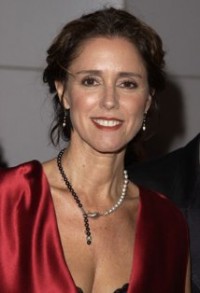
Julie TaymorJulie Taymor, director of theater, movies and opera, held court in New York City recently. Looking about a decade older than her glam publicity handout, but still a decade younger than she actually is (60), she wowed the audience and her fellow panel members, who although they had good information, seemed to be puppets too boring for Taymor to have invented.
The Shakespeare Society of New York sponsored the event, called “Shakespeare Talks: Shakespeare’s Imagery,” featuring Michael Whitmore, director of the Folger Shakespeare Library, and one other talking head, but the night belonged to Taymor.

They discussed the imagery in Shakespeare’s language and how an image can resonate throughout a play as Shakespeare returns to it again and again. Two actors read snippets to illustrate the point.

Taymor talked about how she takes the imagery from Shakespeare and attempts to portray it to the audience. She discussed her films “Titus” and “The Tempest” and how Shakespeare’s imagery affects everything she does from the scenery to the staging to the costumes. Regarding the last, rather than creating them based on the time the play is supposed to depict, she said she gets her inspiration for the costumes directly from the imagery in the piece.

This fall Taymor will direct A Midsummer Night’s Dream at Fort Greene’s Theater for a New Audience in Brooklyn as its debut performance. At this point, she indicated, she still doesn’t know how she’s going to direct the play. She said she tends to read a play or script over and over until she has practically memorized it. Her intensity is such, it seems to me, that she can almost commune with the playwright.

Finally, she talked about where she gets her inspiration. She states that she frequently wakes up early in the morning with interesting ideas for stories or staging. The main difference between her and the rest of us aspiring artistic types is she writes them down or types her ideas into a computer while the rest us, when we get up early with brilliant ideas, think “How nice,” and roll over and go back to sleep.

Posted in Review, Theatre | Tagged A Midsummer Night’s Dream, Folger Shakespeare Library, Julie Taymor, Michael Whitmore, Shakespeare Society of New York, Shakespeare Talks: Shakespeare’s Imagery, The Tempest, Theater for a New Audience, Titus | Leave a reply

House of Cards Has Staying Power

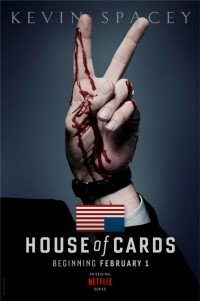
House of CardsHouse of Cards, a new mini-series on Netflix, never falls apart. This adaptation of a British TV drama, based on the novel by Michael Dobbs, stars multi-talented actor Kevin Spacey as Francis “Frank” Underwood, an oily Democratic majority whip, and Robin Wright as his wife, Claire, an unscrupulous non-profit head. The series is humorous and at the same time, very disturbing.
The funny but soulless Frank, turning directly to viewers in asides, mercilessly skewers his fellow politicians. He sees life as a chess game in which he knows each move several stages in advance. And, like a cat, he toys with his victims before destroying them. He may believe in karma, but he does not believe in morality. If you mess with his plans, the result could be fatal.

Claire, a garden-variety manipulator, is suave, well mannered and good-looking, but if you get in her way, you’re so fired. More spider than cat, she is moral up to a point, as long as nobody pushes her. And although she loves her husband, she feels something is missing in their relationship.

In this first season, Frank has an affair with a young reporter, Zoe Barnes, played by Kate Mara, who is desperate, ambitious, and will give anything, including her body, for a great story. Frank gets from her the inside information he needs to advance his schemes and the ability to plant stories to further his career.

One of these schemes is to take a drunken, drug-using, whoring congressman, Peter Russo, played with both manic self-destructive energy and a desire to reform by Corey Stoll, and turn him into a candidate for governor. Frank uses his wife’s non-profit to advance these plans, but in one of his few lapses, fails to see that he’s pushing her too far.

Initially playing to its funny side as Frank speaks directly to us about his machinations, the series turns increasingly dark, leading to a murder that reveals the savageness under Frank’s pleasant, patronizing exterior. By the end of the first season, the series is more political thriller than satire as Frank’s enemies start to figure out his plans.

For those skeptical of politics and politicians, House of Cards will not only reinforce that skepticism, but it will also prove highly entertaining.

Posted in Film, Review | Tagged Claire, Corey Stoll, Francis “Frank” Underwood, House of Cards, Kate Mara, Kevin Spacey, Michael Dobbs, , Peter Russo, Robin Wright, Zoe Barnes | Leave a reply

This Year: Meditations on Aging

Last year we met for lunch. One of the people there, who had just turned 70, was described as “a curmudgeon with a dry sense of humor” but someone who was generous to all and was the life of the party. Two weeks before our get together this year, I received a call from his former girlfriend, saying he had died unexpectedly from a heart aneurism. The memorial service was the day before our reunion. The next day an acquaintance in southern California called to say that his wife’s cancer, which had been in remission, suddenly returned and she had just died.

One of our friends was hiking in the Sierras last year so he couldn’t make it. In response to my e-mail this year, he wrote that he had a slight pain in the chest while in the Sierras followed by massive pain when he returned. He didn’t want to go to the hospital but his wife forced him. He ended up with quadruple heart bypass surgery. He nearly died but is now recovering.

Our reunion this year had considerably fewer people at it. Of the four men present, all in their sixties, two were now sporting canes, one was battling severe diabetes and overweight, and the last, a tennis player with newly reported osteoporosis on his hip was told by his doctor, “Just don’t fall.” The four women on the other hand seemed fine.

In the space of a year we men had gone from looking forward to the future to not having one or just trying to survive into it. What had happened to turn us from active guys into doddering old men, and how could only one year have done this?

Posted in Health, Philosophy | Tagged aging, heart aneurism, heart bypass surgery, osteoporosis, Sierras | 1 Reply

Lawyer Creates Story of Animals, Angst and the Afterlife

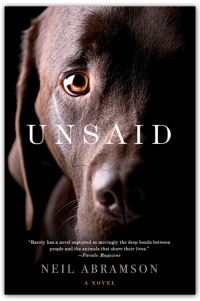
Unsaid: A Novel by Neil Abramson

Unsaid: A Novel
A husband laments the death of his wife; the deceased wife watches him suffer. Ugh. Just shoot me now. But really, it’s not as depressing as it sounds. In fact, it’s not depressing at all.

Unsaid tells a remarkable story of betrayal, forgiveness, animals, humans, and a variety of relationships, all seen through the eyes of a dead woman. The narrator, Helena, was a veterinarian and animal researcher until her early demise from cancer. Now, from some non-earthly realm, she observes those she left behind.

Her husband, David, a lawyer, torn apart by her death, must make peace with the animals she loved, as well as the secret parts of her life he discovers by chance. Unbeknownst to him, Helena had helped a colleague study whether or not a chimp can be taught to communicate using sign language. When the chimp’s life is endangered and crimes are committed, David is dragged into the situation, forcing him to make difficult choices and to come to terms with the truth about the woman he thought he knew so well.

The author, Neil Abramson, a lawyer married to a veterinarian, has created a cast of characters it’s easy to care about, including chimps, pigs, horses, dogs and cats. And even if you don’t think there’s any form of life after death, Abramson’s straightforward style makes a story narrated by a dead woman somehow feel believable, especially as Helena watches her husband struggle with the animals that were once her beloved companions.

In the face of [the horse] Arthur’s obstinacy, David starts tugging on the halter, cursing under his breath. Arthur doesn’t welcome my husband’s hostility. While David still holds the halter, Arthur whips his head around, sending David tumbling into the nearby hay bales.

When David rises unsteadily from the barn floor, he reminds me of Ray Bolger in The Wizard of Oz. His knee joints wobble and hay sticks out of his hair, topcoat, pant legs, and even his socks and shoes. When he walks, hay drops out of his pants as if the hay somehow has become his very essence.

Although a dead woman tells the story, is very much a tale about life, both how and how not to live it. Perhaps the true heart of the book is the nugget of wisdom conveyed to David by an old friend of his wife: Pessimism, cynicism and fear will only lead to a very small life. Don’t live small.

This review originally appeared in the bimonthly newspaper Happy Valley Animals.

When Day Breaks: A Review

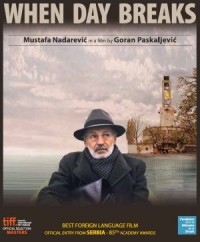
When Day BreaksIf tears aren’t rolling down your cheeks by the second half of When Day Breaks, then you aren’t fully human. This sad but passionate film tells the story of a mild-mannered and retiring (pun intended) music professor who must come to terms with the fact that his life as he knows it is a lie. Raised as a Christian in Serbia, he finds out he is a Jew who was given away by his parents at age two just before they were rounded up and sent to the Judenlager Semlin Concentration Camp in Belgrade.

The level of acting skill displayed in the film is amazing. The portrayal of the nuanced Jewish character Mischa Brankov Weiss by Mustafa Nadarevic is so spot on that I still can’t believe that Mustafa isn’t secretly Jewish. Many of the other actors in their 50’s to 80’s are also remarkable. Rade Kojadinovic as the farmer Kosta Brankov is so good you can almost smell the dried mud on his fingertips.

Mischa, initially incredulous of his new identity and later passionately embracing it, decides to complete the musical script his father buried at the Camp before he died. But what is important to Mischa is less so to the modern Serbians who are more interested in earning a living than remembering a bitter and heinous past. As much a generational conflict as a battle, the young are looking to the future, while the older generation cannot forget its past. Mischa finds comfort with his gypsy friends whose past and present seem equally miserable.

Will Mischa get his piece of music performed and if so by whom? Will it be by the choir he formally led, his son’s orchestra or by someone else? In the end, we are shown a generation that will not go quietly into the night.

Posted in Film, Review | Tagged Christianity, , Judenlager Semlin Concentration Camp, Kosta Brankov, Mischa Brankov Weiss, Mustafa Nadarevic, Rade Kojadinovic, Serbia, When Day Breaks | Leave a reply