
Unsaid: A Novel by Neil Abramson
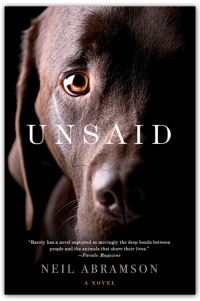
A husband laments the death of his wife; the deceased wife watches him suffer. Ugh. Just shoot me now. But really, it’s not as depressing as it sounds. In fact, it’s not depressing at all.
Unsaid tells a remarkable story of betrayal, forgiveness, animals, humans, and a variety of relationships, all seen through the eyes of a dead woman. The narrator, Helena, was a veterinarian and animal researcher until her early demise from cancer. Now, from some non-earthly realm, she observes those she left behind.
Her husband, David, a lawyer, torn apart by her death, must make peace with the animals she loved, as well as the secret parts of her life he discovers by chance. Unbeknownst to him, Helena had helped a colleague study whether or not a chimp can be taught to communicate using sign language. When the chimp’s life is endangered and crimes are committed, David is dragged into the situation, forcing him to make difficult choices and to come to terms with the truth about the woman he thought he knew so well.
The author, Neil Abramson, a lawyer married to a veterinarian, has created a cast of characters it’s easy to care about, including chimps, pigs, horses, dogs and cats. And even if you don’t think there’s any form of life after death, Abramson’s straightforward style makes a story narrated by a dead woman somehow feel believable, especially as Helena watches her husband struggle with the animals that were once her beloved companions.
In the face of [the horse] Arthur’s obstinacy, David starts tugging on the halter, cursing under his breath. Arthur doesn’t welcome my husband’s hostility. While David still holds the halter, Arthur whips his head around, sending David tumbling into the nearby hay bales.
When David rises unsteadily from the barn floor, he reminds me of Ray Bolger in The Wizard of Oz. His knee joints wobble and hay sticks out of his hair, topcoat, pant legs, and even his socks and shoes. When he walks, hay drops out of his pants as if the hay somehow has become his very essence.
Although a dead woman tells the story, is very much a tale about life, both how and how not to live it. Perhaps the true heart of the book is the nugget of wisdom conveyed to David by an old friend of his wife: Pessimism, cynicism and fear will only lead to a very small life. Don’t live small.
This review originally appeared in the bimonthly newspaper Happy Valley Animals.