
Noah: A Film Review

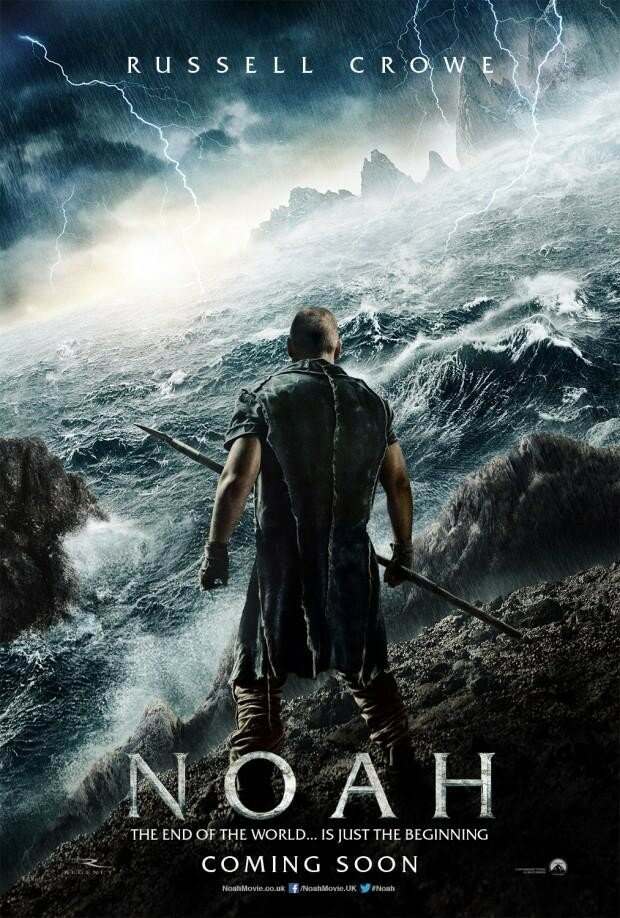
NoahSomewhere in Darren Aronofsky’s more than two hour film is a great movie. With an almost impeccable performance by Russell Crowe as Noah – although not quite Oscar worthy, and a riveting performance by Ray Winstone as Tubal Cain, the film is part The Tree of Life and part Transformers. This schizophrenic coupling gives the movie an unsettling aspect. Fallen angels as stone monsters grapple with more lofty ideals of honor and responsibility to God and family.

Seeing this at the Museum of the Moving Image, the audience and I gave it quarter-hearted applause as we slunk out in the dark during the credits. Said to be a compilation of a three-hour Director’s cut and a shorter studio cut, both of which the target audience didn’t like, this released, and more comprehensible, version will probably please no one.

And yet, as I writhed in pain last night over two herniated discs and an incipient cold, both of which allowed me only fitful sleep, I couldn’t get my mind off the movie. Is there a god, and if so, why doesn’t he speak to us? Or, if he does why is it so difficult to understand him? In this movie, Aronofsky’s unseen God is definitely a “He,” an unyielding, terrorizing, Old Testament God, who gives people no slack, only the rope to hang themselves. Yet the ending anticipates more the God of the New Testament. Is this a redeeming value, or only a way to end an otherwise depressing movie?

As Noah struggles to understand what he thinks his God wants, Tubal Cain struggles with a God he wants to hear but who has abandoned him because of his wickedness. Tubal represents modern man who must struggle in the absence of divine revelation, but as the descendent of Cain, he has already lost that struggle. Nevertheless, his attempts to conquer the world and put it under his dominion is a Sisyphean undertaking in light of the more powerful divine and natural forces that dominate this film’s world.

The Power of Transformation: My Day in the Movies

TransformationUsing Craigslist, my wife and I volunteered to be extras on a movie filming in the New York City area. We submitted a photo and our measurements. We both expected to play tourists visiting a restored nineteenth century village that uses costumed re-enactors. While she did portray a tourist, my fate was different.

We arrived on set at about 11:30 am and signed in with a bubbly young woman who was coordinating the extras. She told us she would try to have us in and out expeditiously. Of course, we waited and waited. We had been told there would be air conditioning, but as the outside temperature approached 100, all we had was two medium-sized electric fans for at least one hundred extras. We therefore decided to go out on the terrace, where the temperature felt at least ten degrees cooler. I had an inkling that something was about to change, when the extra wrangler approached us and told us to come inside and sit near her. She then told me I looked like “The Mayor.”

The wardrobe mistress fetched me and took me to a room where I had two choices of nineteenth-century-style wool jackets whose sleeves were a little long on me, one top hat that mysteriously fit perfectly, and a black cravat. She then sent me back to the hot-box holding room.

A half hour later she came for me again, gave me my clothes, and told me to put them on. A half hour after that, the make-up woman did my face. I was now officially “The Mayor,” clad in three layers of clothing, trying to adjust to the heat. Then I was on call for what turned out to be the next five hours.

Putting on the costume metamorphosed my shy self into an outgoing, talkative personality. When I looked in the mirror, I appeared a little like Abraham Lincoln. The staff started calling me “Mr. Mayor.”  Other extras asked me to pose for pictures with them. One star-struck guy wanted to know what other movies I had been in. A little girl kept giving tea and lemonade to “The Mayor.” Another extra who had brought his own outfit looked like Stan Laurel of the Laurel and Hardy comedy team of the first half of the twentieth century. He was a voice impersonator with a spot-on Bullwinkle and Yoda, and said he had been in more than 100 movies. The SAG-AFTRA actors, normally aloof from the non-union extras, treated me like one of them, sharing their stories with me. One sweet looking young woman had been an international karate champion and had qualified for the Olympics.

Finally, at about 6 pm, those in period costumes took a van to the outdoor area where filming was taking place. Everybody seemed to know my character, including the co-director and her assistants. I was “The Mayor.” I had my picture taken by an official set photographer and by an assistant director. My actual part was fairly small. I was to wave, tip my hat, and greet visitors entering and leaving the park. While I assumed we were filming a comedy, I actually have no idea if my assumption was accurate. When the two stars passed by me, one of them started exaggeratedly bowing to me, which I returned in kind. Through the five takes, it became a game between us.

As we were returning to holding, all the extras, including my wife, were told they could go, except for those dressed in period costumes. The staff at holding hadn’t gotten the message, however, and some told us we could leave as well. I had to inform them we were asked to wait. Finally around 8 pm as the sun was starting to set, all of us, including my wife who had to stay because of me, were summoned back to the set for the last scene to be shot at the park.  My job was similar to the first scene, except I was to thank people for visiting. Because of the lack of time almost no one was able to exit and I would be surprised if I were in frame in the scene.

In most movies the stars are off limits to the extras. You’re not supposed to talk with them or have any contact with them, including eye contact. This time was different. The two stars, who are household names, graciously allowed their pictures to be taken with some of the extras. As “The Mayor,” I was allowed to cut in line to do so with one of them.

I didn’t want to give back my costume, as it had somehow made me other than I was. I had been magically transmuted into a different person and energized. All in all, it was a pleasure for this usually skeptical observer of life, who is now smitten with the acting bug. In this one area, my wife is now more skeptical than I am about looking for more jobs as extras.

What’s Wrong with the New Star Trek Movie?

Star Trek: Into DarknessComing into the movie theater, my wife said, “I’ll only like it if there’s a tribble in it.” She liked it. I guessed the key plot element when I saw the cute, furry ball. I liked it less.

“Into Darkness,” the new Star Trek movie directed by J. J. Abrams, is recycled, but plays well, at least some of the time, with the teenager in all of us. With the whole universe to toy with, literally, Abrams can only give us a rehashed, refried-bean sort of plot, or is it tri-fried? As in “Super 8,” Abrams gives us bits and pieces of other movies, or in this case, mostly Star Trek movies and TV shows.

The opening sequence, a high-action chase scene, whether derivative or an inside joke, is eerily reminiscent of Steven Spielberg’s Raiders of the Lost Ark (1981), in which Indiana Jones is chased by South American Indians. While an obviously expensive scene to film, the aboriginals’ faces here look like five and dime store paper mache masks.

With its recycled plot, “Into Darkness” is still exciting but not awe inspiring. If I could speak with J. J. Abrams, I would tell him he needs to show us the wonder of the universe as well as the foibles of its inhabitants. If Star Trek doesn’t boldly go where no one has gone before, it’s a dud.

With the villain’s superhuman strength and brains, you would think he would be a more complex character, one with a depth of feeling and understanding, yet he is little more than a shadow puppet. A couple of times it appears our déjà vu villain is about to become interesting, but the director always reels him in.

In this attempt, Kirk is the arrogant young man who knows it all; Spock is the monotone hybrid Pinocchio, while Bones is the man of feeling. Uhura is emotive and sexy, so why does she like Spock? Scotty is bland, while Sulu grows a pair when necessary, but the other characters are mostly cardboard cutouts. If their names weren’t called out when they appear, you wouldn’t know who they are.

There is a great movie in there somewhere, but it doesn’t get a chance to develop. If Abrams is going to direct another Star Trek movie, he needs to speak with, and I say this in all humility, someone like me. Star Trek movies need excitement and humor, but they also need awe, irony and blowback.

That is not to say the movie is bad. In fact it’s quite good and highly exciting at points, with great sets and decent 3D effects. Yet, it disappoints. Abrams appears to still be writing for 13 year olds, like in “Super 8,” but some of us have grown up. We want a little wonder with our popcorn and soda.

Model Christy Turlington Burns Says Childbirth Deaths Are Avoidable

Christy Turlington BurnsShe’s on the cover of the June/July 2013 issue of Harper’s Bazaar. She’s one of Fast Company’s most creative people of 2013. And she’s determined to stop women from dying in childbirth.

Every day, roughly one thousand women die from the complications of pregnancy or childbirth, yet most of these deaths are preventable. That’s the message of model and activist Christy Turlington Burns’ documentary “No Woman, No Cry.”

The first-time filmmaker’s own experience with post-partum hemorrhaging after the birth of her daughter, Grace, and a 2005 visit to El Salvador, her mother’s homeland, inspired Turlington Burns to document maternal mortality worldwide.

“It’s a global tragedy,” she said at a screening of the film in New York City, so she decided to tell the stories of women in four different countries.

Turlington Burns first takes us to Tanzania, where a very pregnant Janet must walk five miles to reach a small clinic. She has no food with her, and the clinic provides none. Because her labor has not progressed enough, the health care worker sends her home. When Janet returns to the clinic, she’s so weak that she’s told she must now get to a hospital, a one-hour drive away. The van to take her costs $30, more than one month’s income for Janet’s family. Turlington Burns provides the money, and Janet gives birth to a healthy boy.

Tanzania lacks adequate health care facilities and medical personnel, as do most developing nations, with only one obstetrician for every 2.5 million people. With more and better facilities, women like Janet don’t need to die, as she surely would have if the film crew had not been there.

In Bangladesh, the issues are different. Health care facilities are often close by, yet most women will not use them because of the social stigma attached: it’s considered shameful to give birth outside the home. With proper education, however, attitudes can change. When a health care worker counsels Monica, who is ashamed to seek medical help, she finally agrees to have her baby in a hospital, leading to a happy outcome – the birth of a son.

In Guatemala, Turlington Burns encounters yet another issue. Abortion is illegal, even in cases of rape and incest. So when a young woman becomes pregnant as a result of rape, her illegal abortion almost kills her; it takes nearly six weeks of hospitalization for her to recover. Changing religiously based norms is probably the toughest challenge regarding maternal health, but it can happen, Turlington Burns argues.

Although 99 percent of childbirth-related deaths occur in the developing world, the United States has vast room for improvement, ranking 50th in maternal mortality. Women of color are especially vulnerable, as are those who have no health insurance.

“Being uninsured and pregnant is a disaster,” said Jennie Joseph, a Florida midwife featured in the film.

Ironically, the only woman who dies of childbirth-related complications in the documentary is an American woman who succumbs to an amniotic fluid aneurism. Turlington Burns shows the toll her death takes on her family with sensitivity and compassion.

Two years in the making, “” can be purchased on iTunes and Amazon.

We Steal Secrets: The Story of WikiLeaks

We Steal Secrets: The Story Of WikileaksIf you’re looking for a Michael Moore style documentary where you know the good guys from the bad guys, then this movie is not for you. While the first fifteen minutes appeared to detail the heroism of Julian Assange against the misdeeds of the U.S. government, the following two hours depicted a far more complex reality in which people may do the right things for the wrong reasons, or the wrong things with laudable goals in mind. Director Alex Gibney doesn’t give us a Moore fable or an Oliver Stone lesson in propaganda, but rather a complex study of an Icarus-themed Assange and a tortured but saint-like Private Bradley Manning.
When Assange dumped thousands of documents about the U.S.’s handling of the Afghanistan war without redacting the names of the locals who worked with the U.S. government, Assange went from hero to arrogant bastard. For him it was more important to get the word out regardless of whom it hurt or killed. Admittedly, Assange’s WikiLeaks turns out to be more a one-man organization than a dedicated band of Robin Hoods who steal from the U.S. government to give to the world. Did Assange care that people might die to facilitate the better free flow of information, or was he simply unable to redact the affected peoples names with a lack of staff and approaching deadlines for the release of information? We may never know.

As we delve into the personalities of Assange, and Private Manning who illegally downloaded hundreds of thousand of documents from the U.S. government, we find that both men are damaged goods. Assange was an unloved child whose mother divorced several times and who was shunted around more than thirty residences in Australia. Manning was a small, slightly effeminate gay who was bullied in school and not sure of his gender. From a divorced family with an alcoholic mother, he also felt himself very much alone. Whatever their environment and resultant personality failures, both were computer geniuses.

But overarching questions remain. When can the most powerful government in the world keep information hidden, and when must it release it? Is the embarrassment of inadvertently killing journalists in Iraq enough of a reason? Is potentially outing collaborators sufficient, and who decides and why and how?

In the Army, you’re supposed to follow orders, not your conscience. So, for Private Manning, it was a three-fer, not only was he a lonely homosexual with a stronger conscience because of what he had experienced, but he also felt that he was a woman trapped in a man’s body – and he had no one to turn to for help. The only surprise was how long it took him to unravel or to grow a pair – it all depends on your point of view.

So, if there is a hero in this mess, it’s probably not Julian Assange, whose dark side was more fitted to playing Darth Vader than Han Solo. Two damaged boys grow up to be damaged young men who want to get even with society, or, from a rosier point of view, men who want to change society and the U.S. government into something it isn’t. Beware of what you wish for: The consequences may be more severe than you imagined.

House of Cards Has Staying Power

House of CardsHouse of Cards, a new mini-series on Netflix, never falls apart. This adaptation of a British TV drama, based on the novel by Michael Dobbs, stars multi-talented actor Kevin Spacey as Francis “Frank” Underwood, an oily Democratic majority whip, and Robin Wright as his wife, Claire, an unscrupulous non-profit head. The series is humorous and at the same time, very disturbing.
The funny but soulless Frank, turning directly to viewers in asides, mercilessly skewers his fellow politicians. He sees life as a chess game in which he knows each move several stages in advance. And, like a cat, he toys with his victims before destroying them. He may believe in karma, but he does not believe in morality. If you mess with his plans, the result could be fatal.

Claire, a garden-variety manipulator, is suave, well mannered and good-looking, but if you get in her way, you’re so fired. More spider than cat, she is moral up to a point, as long as nobody pushes her. And although she loves her husband, she feels something is missing in their relationship.

In this first season, Frank has an affair with a young reporter, Zoe Barnes, played by Kate Mara, who is desperate, ambitious, and will give anything, including her body, for a great story. Frank gets from her the inside information he needs to advance his schemes and the ability to plant stories to further his career.

One of these schemes is to take a drunken, drug-using, whoring congressman, Peter Russo, played with both manic self-destructive energy and a desire to reform by Corey Stoll, and turn him into a candidate for governor. Frank uses his wife’s non-profit to advance these plans, but in one of his few lapses, fails to see that he’s pushing her too far.

Initially playing to its funny side as Frank speaks directly to us about his machinations, the series turns increasingly dark, leading to a murder that reveals the savageness under Frank’s pleasant, patronizing exterior. By the end of the first season, the series is more political thriller than satire as Frank’s enemies start to figure out his plans.

For those skeptical of politics and politicians, House of Cards will not only reinforce that skepticism, but it will also prove highly entertaining.

Posted in Film, Review | Tagged Claire, Corey Stoll, Francis “Frank” Underwood, House of Cards, Kate Mara, Kevin Spacey, Michael Dobbs, , Peter Russo, Robin Wright, Zoe Barnes | Leave a reply

When Day Breaks: A Review

When Day BreaksIf tears aren’t rolling down your cheeks by the second half of When Day Breaks, then you aren’t fully human. This sad but passionate film tells the story of a mild-mannered and retiring (pun intended) music professor who must come to terms with the fact that his life as he knows it is a lie. Raised as a Christian in Serbia, he finds out he is a Jew who was given away by his parents at age two just before they were rounded up and sent to the Judenlager Semlin Concentration Camp in Belgrade.

The level of acting skill displayed in the film is amazing. The portrayal of the nuanced Jewish character Mischa Brankov Weiss by Mustafa Nadarevic is so spot on that I still can’t believe that Mustafa isn’t secretly Jewish. Many of the other actors in their 50’s to 80’s are also remarkable. Rade Kojadinovic as the farmer Kosta Brankov is so good you can almost smell the dried mud on his fingertips.

Mischa, initially incredulous of his new identity and later passionately embracing it, decides to complete the musical script his father buried at the Camp before he died. But what is important to Mischa is less so to the modern Serbians who are more interested in earning a living than remembering a bitter and heinous past. As much a generational conflict as a battle, the young are looking to the future, while the older generation cannot forget its past. Mischa finds comfort with his gypsy friends whose past and present seem equally miserable.

Will Mischa get his piece of music performed and if so by whom? Will it be by the choir he formally led, his son’s orchestra or by someone else? In the end, we are shown a generation that will not go quietly into the night.

Posted in Film, Review | Tagged Christianity, , Judenlager Semlin Concentration Camp, Kosta Brankov, Mischa Brankov Weiss, Mustafa Nadarevic, Rade Kojadinovic, Serbia, When Day Breaks | Leave a reply

Project Nim (2011) – Thoughtless Experiment Takes a Toll on Chimp and Humans

Project NimMovie Review: Project Nim (2011), available on DVD and HBO

This true tale of a hippy-dippy “science” project run amok will leave you queasy. From the woman who breast feeds a baby chimp, to the research director who sleeps with his assistants, no one in the documentary Project Nim, which chronicles a 1970s experiment to see if a chimp can learn sign language and then follows him through various travails, seems capable of establishing boundaries. In fact, so many social and scientific lines are crossed that the value of the experiment is highly questionable, at best.

After the six-week-old Nim is heartrendingly separated from his mother, he’s raised in a home with seven kids and hippie parents who share their pot with Nim, don’t know sign language, and have no concept of what a scientific experiment should include, such as record keeping or schedules. Although the rambunctious Nim seems happy there, playing with the kids and pets, he takes an intense dislike to the father of the family, to the point of biting him. This is only the first wedge that Nim drives between the people involved in the experiment.

Reminiscent of , the film is really about the conflicts among the humans in Nim’s life and the resulting toll those disagreements take on the animal. Arguments arise over where and how he’s taught, where he should live, and who should control him and the experiment. As Nim starts to behave more and more like a wild chimp, the decision is made to remove him from the home to be raised by a young woman whom Dr. Herbert Terrace, the project director, has the hots for.

Director James Marsh skillfully elicits from his interviewees the emotional impact of the project, including an account from one young researcher whose affair with Dr. Terrace ends abruptly and painfully. Many tears are shed by all involved, except the stone-faced doctor, but Nim’s first human mother sums up the project’s effect on Nim most aptly: “We made a commitment to him and we failed. We did a disservice to that soul.”

As the chimp grows older, he gets more aggressive, including tearing open the side of a woman’s face, and Dr. Terrace finally realizes the experiment must end. Nim is shipped off to a creepy medical research facility and then to an animal sanctuary, but it’s not clear which place is worse.

provides a fascinating look at the antics of the anything-goes ’70s and serves as a stark reminder that when humans put their emotional needs first, helpless creatures often pay a very high price. If the tale of Nim’s Dickensian life doesn’t leave you teary-eyed, you’re not a worthy primate.

This review originally appeared in the bimonthly newspaper Happy Valley Animals.