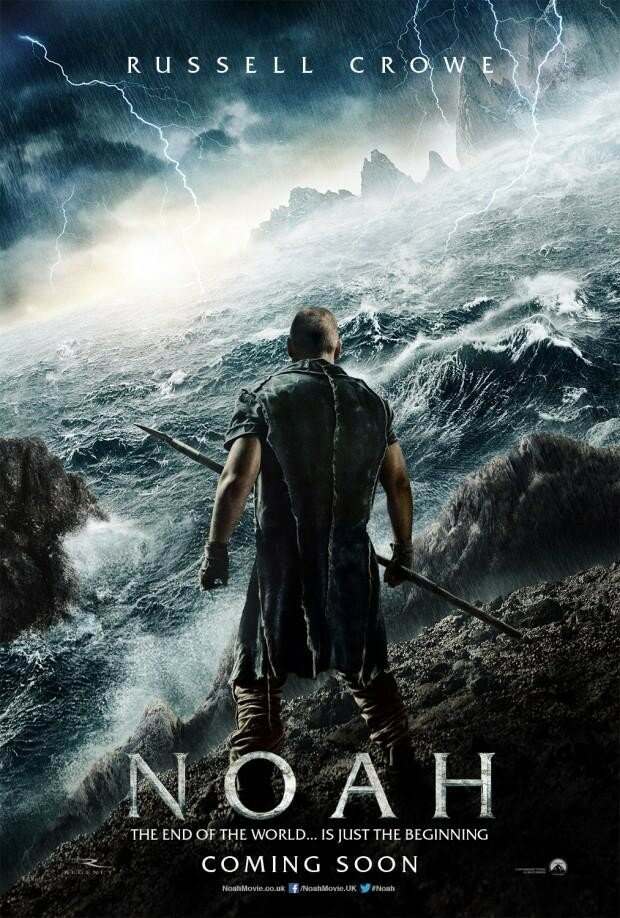
Noah: A Film Review

NoahSomewhere in Darren Aronofsky’s more than two hour film is a great movie. With an almost impeccable performance by Russell Crowe as Noah – although not quite Oscar worthy, and a riveting performance by Ray Winstone as Tubal Cain, the film is part The Tree of Life and part Transformers. This schizophrenic coupling gives the movie an unsettling aspect. Fallen angels as stone monsters grapple with more lofty ideals of honor and responsibility to God and family.


Seeing this at the Museum of the Moving Image, the audience and I gave it quarter-hearted applause as we slunk out in the dark during the credits. Said to be a compilation of a three-hour Director’s cut and a shorter studio cut, both of which the target audience didn’t like, this released, and more comprehensible, version will probably please no one.

And yet, as I writhed in pain last night over two herniated discs and an incipient cold, both of which allowed me only fitful sleep, I couldn’t get my mind off the movie. Is there a god, and if so, why doesn’t he speak to us? Or, if he does why is it so difficult to understand him? In this movie, Aronofsky’s unseen God is definitely a “He,” an unyielding, terrorizing, Old Testament God, who gives people no slack, only the rope to hang themselves. Yet the ending anticipates more the God of the New Testament. Is this a redeeming value, or only a way to end an otherwise depressing movie?

As Noah struggles to understand what he thinks his God wants, Tubal Cain struggles with a God he wants to hear but who has abandoned him because of his wickedness. Tubal represents modern man who must struggle in the absence of divine revelation, but as the descendent of Cain, he has already lost that struggle. Nevertheless, his attempts to conquer the world and put it under his dominion is a Sisyphean undertaking in light of the more powerful divine and natural forces that dominate this film’s world.

Turkey: The Country not the Bird

My wife and I recently returned from a cruise in the Mediterranean where we saw the sites of Italy, Greece and Turkey. I had thought that Erdogan’s Islamization of Turkey would have made it a very repressive country, and that Attaturk’s vision of a secular Turkey was as dead and buried as he was. I also thought that Italy and Greece were mostly western countries in the mold of Western Europe. What I found was the opposite.

While I loved visiting Italy and Greece once again, the impression I received was one of vibrant Third World countries that didn’t use credit cards — I constantly had to change dollars into euros in Rome and Athens – and countries that would be more at home in Eastern Europe. However, the museums were fantastic — even though you don’t know when parts of them will closed at weird hours for lack of money. The ancient Roman and Greek sites made it feel as if Rome and Greece still ruled the world, but those days are definitely millennia passed.

I expected Turkey to be similar, and it was in regard to credit cards, but it was much stranger than Italy or Greece. Arriving in Istanbul, the first thing you notice are the mosques, hundreds of them adorning the cityscape. I felt as if I’d arrived in an alien world where the mosques almost seemed as if they were flying saucers that had temporarily landed.

Istanbul, Turkey

One thing the government under the General Directorate of Foundations is trying to do is to reconvert museums and churches into mosques. There are no shortage of mosques, and according to the locals, one does not need a mosque to pray. Those that have been reconverted include the thirteenth century Haghia Sophia Church in Trabzon. As another example, after an earthquake in Istanbul in 1999, the sixth century Church of St. Sergius and Bacchus . The present Islamic government of Turkey has a choice to make. So far, they seem to be making the wrong one.

Once you acclimate yourself to the ever present mosques, you will notice how western the city of Istanbul really is. You feel you could be in Belgium, England or even the US. The people we met, especially the younger generation were decidedly modern and anti-Erdogan. They appreciated western values and didn’t want to give them up. Even one religious young man who was trying to find his place within Islam didn’t want to give up the freedoms his generation has sampled. While Erdogan may wish proudly to lead his people back to the seventh century, the modern generation is more than happy to remain in the twenty-first, and some of them are willing to fight for their freedoms. Attaturk may not be dead after all.

In many ways Istanbul is a modern city, it is a hub for international business and a modern cosmopolitan city. Even in the nineteenth century spice bazaar, you can get your Turkish Delight candy specially cut for you and then have the box shrink wrapped for freshness and to go easily through customs. But it is also pays attention to its traditional side in the care it takes to present its time-honored Mediterranean cooking. Its vegetarian tradition is beyond compare. In short, Turkey has the best of the old and the new. My wife and I liked it so much that we are thinking of going back in the spring. With the warmth of its people, its western and eastern flavors and its marvelous ancient archaeological sites, Turkey is a better than Disneyland because it’s all real. If its government can avoid wrecking it, Turkey will remain a wonder of the ancient and modern world.

The Power of Transformation: My Day in the Movies

TransformationUsing Craigslist, my wife and I volunteered to be extras on a movie filming in the New York City area. We submitted a photo and our measurements. We both expected to play tourists visiting a restored nineteenth century village that uses costumed re-enactors. While she did portray a tourist, my fate was different.

We arrived on set at about 11:30 am and signed in with a bubbly young woman who was coordinating the extras. She told us she would try to have us in and out expeditiously. Of course, we waited and waited. We had been told there would be air conditioning, but as the outside temperature approached 100, all we had was two medium-sized electric fans for at least one hundred extras. We therefore decided to go out on the terrace, where the temperature felt at least ten degrees cooler. I had an inkling that something was about to change, when the extra wrangler approached us and told us to come inside and sit near her. She then told me I looked like “The Mayor.”

The wardrobe mistress fetched me and took me to a room where I had two choices of nineteenth-century-style wool jackets whose sleeves were a little long on me, one top hat that mysteriously fit perfectly, and a black cravat. She then sent me back to the hot-box holding room.

A half hour later she came for me again, gave me my clothes, and told me to put them on. A half hour after that, the make-up woman did my face. I was now officially “The Mayor,” clad in three layers of clothing, trying to adjust to the heat. Then I was on call for what turned out to be the next five hours.

Putting on the costume metamorphosed my shy self into an outgoing, talkative personality. When I looked in the mirror, I appeared a little like Abraham Lincoln. The staff started calling me “Mr. Mayor.”  Other extras asked me to pose for pictures with them. One star-struck guy wanted to know what other movies I had been in. A little girl kept giving tea and lemonade to “The Mayor.” Another extra who had brought his own outfit looked like Stan Laurel of the Laurel and Hardy comedy team of the first half of the twentieth century. He was a voice impersonator with a spot-on Bullwinkle and Yoda, and said he had been in more than 100 movies. The SAG-AFTRA actors, normally aloof from the non-union extras, treated me like one of them, sharing their stories with me. One sweet looking young woman had been an international karate champion and had qualified for the Olympics.

Finally, at about 6 pm, those in period costumes took a van to the outdoor area where filming was taking place. Everybody seemed to know my character, including the co-director and her assistants. I was “The Mayor.” I had my picture taken by an official set photographer and by an assistant director. My actual part was fairly small. I was to wave, tip my hat, and greet visitors entering and leaving the park. While I assumed we were filming a comedy, I actually have no idea if my assumption was accurate. When the two stars passed by me, one of them started exaggeratedly bowing to me, which I returned in kind. Through the five takes, it became a game between us.

As we were returning to holding, all the extras, including my wife, were told they could go, except for those dressed in period costumes. The staff at holding hadn’t gotten the message, however, and some told us we could leave as well. I had to inform them we were asked to wait. Finally around 8 pm as the sun was starting to set, all of us, including my wife who had to stay because of me, were summoned back to the set for the last scene to be shot at the park.  My job was similar to the first scene, except I was to thank people for visiting. Because of the lack of time almost no one was able to exit and I would be surprised if I were in frame in the scene.

In most movies the stars are off limits to the extras. You’re not supposed to talk with them or have any contact with them, including eye contact. This time was different. The two stars, who are household names, graciously allowed their pictures to be taken with some of the extras. As “The Mayor,” I was allowed to cut in line to do so with one of them.

I didn’t want to give back my costume, as it had somehow made me other than I was. I had been magically transmuted into a different person and energized. All in all, it was a pleasure for this usually skeptical observer of life, who is now smitten with the acting bug. In this one area, my wife is now more skeptical than I am about looking for more jobs as extras.

Ten Ways To Tell if You’re an Anti-Semite (with apologies to David Letterman)

10. You’re careful to specify that you’re not an anti-Semite, only anti-Zionist.

9. Your definition of a non-violent protest is one in which the Palestinians only throw rocks and Molotov cocktails.

8. You think Israel is a racist state because it’s mainly for Jews, but you don’t think the 52 Islamic states are racist because they’re mainly for Muslims.

7. You think BDS (Boycotts, Divestment and Sanctions) just wants Israel to go back to its 1967 borders (that are in reality the 1949 Armistice lines).

6. You believe that the Mavi Marmara, one of the six ships sent from Turkey to break the Israeli blockade of Hamas-run Gaza, was just carrying aid to the Palestinians.

5. You believe that suicide bombing against Israeli civilians is okay, but you’re horrified at the Boston bombing.

4. You believe that Palestinians can do what they want to Israelis, but any counter measures by the Israelis are automatically war crimes.

3. You’re willing to speak out and volunteer for the Palestinian cause, but you wouldn’t do so for the Tibetan, Cypriote, Kurdish or other causes.

2. You feel that because you’re against many of the things the West does, including capitalism and intervention in Third World countries, that you automatically have to be against Israel, the invention of the West.

1. After reading the above nine reasons, you still think you’re only anti-Zionist.

Free Comedy of Errors Swings into Central Park

ShakespeareIf there’s one thing I hate, it is Shakespeare in modern drag. All these presumptuous directors think they can do Shakespeare one better. So, when my wife suggested we get free tickets to the Public Theater’s “The Comedy of Errors” at the Delacorte Theater in Central Park, my first thought was I didn’t want to go. My second thought was that a 1930s version of twins lost and found was probably worth the ticket price: exactly nothing. At least, I thought, our chance of getting tickets was practically nil. So when my wife excitedly announced we had two tickets, I resigned myself to a night of tortured transpositions.

When we entered the theater at 8:10 pm (start time 8:30), I was thinking about why I don’t like updated Shakespeare. In this case, it’s because it’s too much of a jump from a 16th century staging, with the play taking place in Ephesus, Turkey, to a 20th century one in upstate New York, without some sort of bridge between them to help suspend disbelief. Also, when directors try to modernize a Shakespearian play, so many of them get it grievously wrong. It’s usually either clunky and/or risible. Yet here, when we sat down, rather than facing a normally empty stage, surprisingly, several actors were hanging out at a dance hall. When they started to dance, with their swing-inspired moves, I was hooked.

Between scenes, the dancers also entertained, so the energetic pace of the show never wavered, nor did the audience’s enthusiasm. In fact, the dancing was so infectious that I was able to suspend disbelief over a 400+ year jump in the date and place of the setting. Through the dancers, the bridge across time and place was easily crossed, drawing us into 1930s upstate New York, complete with a Hopperesque set, an expanded version of the Edward Hopper work “Early Sunday Morning,” painted in 1930, and now on view at the Whitney Museum. In Central Park, there’s a statue of Shakespeare done by John Quincy Adams Ward that Hopper painted. It appears that the Public Theater is returning the favor and completing the homage.

Often when a director updates a play it appears awkward, but here, as in the recent update (2011) of “The Merchant of Venice” starring F. Murray Abraham, it works because of the dynamism of the actors, the staging and the nuance and insight of the director.

I am now a convert to modern staging of the Bard. Director Daniel Sullivan has won me to the cause. Even Shakespeare would have been proud. Hamish Linklater as the Antipholus twins and Jesse Tyler Ferguson as the Dromio servant twins steal and steel the show. The noble twins are the straight men, while the servant twins are the comedians. The slapstick works and works well, with more laughs in this version of the play than in any other I’ve seen. Perhaps Shakespeare was the Mel Brooks of his time, but it took a director like Sullivan to show us this.

What’s Wrong with the New Star Trek Movie?

Star Trek: Into DarknessComing into the movie theater, my wife said, “I’ll only like it if there’s a tribble in it.” She liked it. I guessed the key plot element when I saw the cute, furry ball. I liked it less.

“Into Darkness,” the new Star Trek movie directed by J. J. Abrams, is recycled, but plays well, at least some of the time, with the teenager in all of us. With the whole universe to toy with, literally, Abrams can only give us a rehashed, refried-bean sort of plot, or is it tri-fried? As in “Super 8,” Abrams gives us bits and pieces of other movies, or in this case, mostly Star Trek movies and TV shows.

The opening sequence, a high-action chase scene, whether derivative or an inside joke, is eerily reminiscent of Steven Spielberg’s Raiders of the Lost Ark (1981), in which Indiana Jones is chased by South American Indians. While an obviously expensive scene to film, the aboriginals’ faces here look like five and dime store paper mache masks.

With its recycled plot, “Into Darkness” is still exciting but not awe inspiring. If I could speak with J. J. Abrams, I would tell him he needs to show us the wonder of the universe as well as the foibles of its inhabitants. If Star Trek doesn’t boldly go where no one has gone before, it’s a dud.

With the villain’s superhuman strength and brains, you would think he would be a more complex character, one with a depth of feeling and understanding, yet he is little more than a shadow puppet. A couple of times it appears our déjà vu villain is about to become interesting, but the director always reels him in.

In this attempt, Kirk is the arrogant young man who knows it all; Spock is the monotone hybrid Pinocchio, while Bones is the man of feeling. Uhura is emotive and sexy, so why does she like Spock? Scotty is bland, while Sulu grows a pair when necessary, but the other characters are mostly cardboard cutouts. If their names weren’t called out when they appear, you wouldn’t know who they are.

There is a great movie in there somewhere, but it doesn’t get a chance to develop. If Abrams is going to direct another Star Trek movie, he needs to speak with, and I say this in all humility, someone like me. Star Trek movies need excitement and humor, but they also need awe, irony and blowback.

That is not to say the movie is bad. In fact it’s quite good and highly exciting at points, with great sets and decent 3D effects. Yet, it disappoints. Abrams appears to still be writing for 13 year olds, like in “Super 8,” but some of us have grown up. We want a little wonder with our popcorn and soda.

We Steal Secrets: The Story of WikiLeaks

We Steal Secrets: The Story Of WikileaksIf you’re looking for a Michael Moore style documentary where you know the good guys from the bad guys, then this movie is not for you. While the first fifteen minutes appeared to detail the heroism of Julian Assange against the misdeeds of the U.S. government, the following two hours depicted a far more complex reality in which people may do the right things for the wrong reasons, or the wrong things with laudable goals in mind. Director Alex Gibney doesn’t give us a Moore fable or an Oliver Stone lesson in propaganda, but rather a complex study of an Icarus-themed Assange and a tortured but saint-like Private Bradley Manning.

When Assange dumped thousands of documents about the U.S.’s handling of the Afghanistan war without redacting the names of the locals who worked with the U.S. government, Assange went from hero to arrogant bastard. For him it was more important to get the word out regardless of whom it hurt or killed. Admittedly, Assange’s WikiLeaks turns out to be more a one-man organization than a dedicated band of Robin Hoods who steal from the U.S. government to give to the world. Did Assange care that people might die to facilitate the better free flow of information, or was he simply unable to redact the affected peoples names with a lack of staff and approaching deadlines for the release of information? We may never know.

As we delve into the personalities of Assange, and Private Manning who illegally downloaded hundreds of thousand of documents from the U.S. government, we find that both men are damaged goods. Assange was an unloved child whose mother divorced several times and who was shunted around more than thirty residences in Australia. Manning was a small, slightly effeminate gay who was bullied in school and not sure of his gender. From a divorced family with an alcoholic mother, he also felt himself very much alone. Whatever their environment and resultant personality failures, both were computer geniuses.

But overarching questions remain. When can the most powerful government in the world keep information hidden, and when must it release it? Is the embarrassment of inadvertently killing journalists in Iraq enough of a reason? Is potentially outing collaborators sufficient, and who decides and why and how?

In the Army, you’re supposed to follow orders, not your conscience. So, for Private Manning, it was a three-fer, not only was he a lonely homosexual with a stronger conscience because of what he had experienced, but he also felt that he was a woman trapped in a man’s body – and he had no one to turn to for help. The only surprise was how long it took him to unravel or to grow a pair – it all depends on your point of view.

So, if there is a hero in this mess, it’s probably not Julian Assange, whose dark side was more fitted to playing Darth Vader than Han Solo. Two damaged boys grow up to be damaged young men who want to get even with society, or, from a rosier point of view, men who want to change society and the U.S. government into something it isn’t. Beware of what you wish for: The consequences may be more severe than you imagined.

The Jerusalem Post Conference and Caroline Glick

Caroline GlickThe second annual Jerusalem Post Conference, subtitled Fighting for the Zionist Dream, was held in New York City rather than Jerusalem – probably to attract the widest possible audience of supporters of Zionism and Israel.

The highlight of the conference was the speech and later panel appearance by the polarizing senior contributing editor of the Jerusalem Post and editor of Latma, Caroline Glick.

Latma, which is similar in concept to Jon Stewart’s The Daily Show except with satirical songs thrown in, depicts two leftist and clueless television reporters editorializing on the current Israel-related news. Cutting through all the propaganda surrounding events, such as the Mavi Marmara flotilla, the songs can be devastatingly funny and spot-on accurate. The flotilla song We Con the World (sung to the tune of We are the World) drew millions of hits and was worth more to the Israeli side than any hasbara, as it countered the exasperated horror routinely expected from the Arab world and the EU. To say that Ms. Glick is an Israeli national treasure would be an understatement.

Born into a middle-class Jewish home in Chicago, she was raised in a traditional left-leaning liberal environment. After making aliyah to Israel, she claimed to have come to understand realpolitik. To her, leftists are fools who wish for a world that doesn’t and will never exist. For example, the fact that Israelis, Americans, and the European countries want there to be peace in the Middle East and want there to be a two-state solution for Israel and the Palestinians, doesn’t mean that the Palestinians or the Arab world wants the same. She believes that the Palestinians will never give up the idea of the destruction of Israel and at best will yield to a two-stage solution in which the Jewish state is first stripped of defensible borders and is then attacked with missiles and bombs until it is defeated, whether it takes decades or centuries. She has a long-term strategist’s view of the Middle East that is not pleasant, but certainly devastating.

Thus, when she speaks even to a pro-Israel audience, she can be condescending, and when she replies to other speakers, she can be dripping with sarcasm and animus. She is like an elementary school teacher who must tell a clueless kindergartner over and over again not to place his wet hand over an electrical outlet. Like the greater public, the student never quite gets the danger even if he is shocked over and over.

Like Snidely Whiplash, the evil enemy of Dudley Do-Right in Rocky and Bullwinkle Show, she curled her lip in a snarl that said it all. Except in this version, she was the hero and Dudley was a dud who didn’t know what he was doing. She is brilliant, incisive, cutting and just a shade paranoid. But in the world she lives in, paranoia can be life saving.

So is she the wunderkind of Israeli politics or just the enfant terrible? Maybe she is just an acerbic Daniel Patrick Moynihan, who, against the wishes of his superiors, railed at the UN against the passing of the Zionism is Racism resolution in 1975. I believe she is a brilliant person – with a blind spot. That is, she doesn’t see that we Americans do see what an impossible and unfair situation Israel is in. Where anything Jews do is biased and under-handed, whereas whatever their opponents do is above-board and laudable. Where suicide bombing and indiscriminate rockets are simply tools of resistance, but Israeli defense is a war crime. Where an American Jew is accused of dual loyalty if he supports Israel, but an Irish American is just supporting his heritage when he supports Ireland. Where 12 million Jews are said to control the world, while a billion Moslems are helpless and a billion Christians wring their hands in silence. In such a world, it is not surprising that Caroline Glick is angry and frustrated. It is only surprising that more of us citizens of the world are not.

Glick does not think too highly of Americans. When she started her presentation, she stated that she would much rather speak on another topic, but that we Americans needed to hear her. She said that the purpose of the BDS (boycotts, divestment and sanctions) movement was the destruction of the state of Israel, not just the elimination of Israel from the West Bank. She asked why Jews are inviting anti-Semites, including former President Carter and BDS members to speak at Jewish forums? Are we fools and dupes?

After the 1973 Israeli–Arab war in which Israel conquered the West Bank, part of Jerusalem, and the Golan Heights, the international left abandoned Israel. Leftist Jews now join with Israel’s enemies to destroy it, while stating how courageous they are. But Israel and American Jews need each other, and might not survive without each other. There is an unwillingness to call things by their names. These are uncomfortable truths. Glick is very angry but still hopeful.

My problem with Caroline Glick is that I think the majority of Americans, including a majority of Jews, do understand Israeli-Arab problems and the unremitting prejudice against Israel from the Arab world, many EU countries, and especially the UN. I see a perceptible turning to Israel even among the twenty-somethings who are traditionally more to the left of the political spectrum. , the contemporary news site of the young, has gotten consistently more pro-Israel in its reader comments.  Several years ago, the majority of the readers’ comments were anti-Israel; today, the majority are either pro-Israel or at least understanding of its positions. In fact, I see that Israel today is in a far stronger position than its friends think and its enemies desire.