
The Extraordinary Tale of the Bermuda Petrel and the Man who Brought It Back from Extinction

Book Review:

Rare Birds: The Extraordinary Tale of the Bermuda Petrel and the Man who Brought It Back from Extinction by Elizabeth Gehrman

Rare Birds: The Extraordinary Tale of the Bermuda PetrelCrazy, eccentric curmudgeon or self-sacrificing saint? David Wingate, who almost single-handedly resurrected the near-extinct cahow, a type of petrel, is both. The Bermuda native has devoted his life to assuring the survival of a creature once so docile, abundant, and unfortunately for them, delicious, that early visitors to Bermuda, standing in one spot, easily killed four thousand in a single night.

Gehrman’s fascinating and thoroughly researched account describes how Wingate frequently risked his life on the tiny, jagged islands that compose Bermuda, fighting rough seas, hurricanes, rocky shores, and even the U.S. military, to study the cahow, long thought to be extinct. Wingate constructed artificial burrows, warded off predators, and replanted vegetation by hand, all in the name of reviving a species that was nearly wiped out in the early 1600s.

As a teenage birder in 1951, Wingate was present when American ornithologist Robert Cushman Murphy and Louis S. Mowbray of the Bermuda Aquarium discovered the first living cahow seen in 330 years, on a tiny islet called Inner Pear. At that point Wingate was hooked and became determined to restore the cahow to Bermuda, no matter what the cost. Personal discomfort meant little to him. He often spent cold, wet nights without shelter on uninhabited islands, studying the nocturnal seabirds, trying to figure out how to turn 14 birds into a viable population.

After earning a degree in zoology from Cornell University in 1957, Wingate returned home to tackle the problem of helping the cahow survive by creating devices that prevented other types of birds from getting into the cahows’ burrows. Along with their revival, Wingate came up with the idea of restoring an abandoned island called Nonsuch to its precolonial state, including, he hoped, breeding grounds for the cahow. In 1962, Wingate, his pregnant wife Anita, and their toddler moved to the island, which had few modern conveniences, making daily living quite a challenge.

There was as yet no dock at the protected north beach, so everything the young family needed – furniture, tools, books, food, clothing, and diapers; blocks of ice, since there was no refrigerator; lanterns, since there was no electricity; eighty-pound propane cylinders to fuel the stove; five-gallon cans of gas for the generator that started the pressure system to pump rainwater from the cistern to the house – had to be dragged over the beach, past the bones of cedars, through the scrub, and to the compound, three hundred yards away and uphill every step.

Wingate stuck it out on the island, hand-planting native habitat and destroying invasive species, despite horrific family tragedy and inane government bureaucracy, until finally forced to retire and leave Nonsuch in 2000. By then, three times as many breeding cahows and three times as many fledglings existed on various islets in Bermuda versus when Wingate began his work in 1962. However, he had yet to see them return to nest on Nonsuch. Finally, on a rare night visit to the island in 2011, Wingate saw about 10 cahows fluttering above him, a thrilling culmination to his astounding life’s work.

This review originally appeared in the bimonthly newspaper Happy Valley Animals.

Model Christy Turlington Burns Says Childbirth Deaths Are Avoidable

Christy Turlington BurnsShe’s on the cover of the June/July 2013 issue of Harper’s Bazaar. She’s one of Fast Company’s most creative people of 2013. And she’s determined to stop women from dying in childbirth.

Every day, roughly one thousand women die from the complications of pregnancy or childbirth, yet most of these deaths are preventable. That’s the message of model and activist Christy Turlington Burns’ documentary “No Woman, No Cry.”

The first-time filmmaker’s own experience with post-partum hemorrhaging after the birth of her daughter, Grace, and a 2005 visit to El Salvador, her mother’s homeland, inspired Turlington Burns to document maternal mortality worldwide.

“It’s a global tragedy,” she said at a screening of the film in New York City, so she decided to tell the stories of women in four different countries.

Turlington Burns first takes us to Tanzania, where a very pregnant Janet must walk five miles to reach a small clinic. She has no food with her, and the clinic provides none. Because her labor has not progressed enough, the health care worker sends her home. When Janet returns to the clinic, she’s so weak that she’s told she must now get to a hospital, a one-hour drive away. The van to take her costs $30, more than one month’s income for Janet’s family. Turlington Burns provides the money, and Janet gives birth to a healthy boy.

Tanzania lacks adequate health care facilities and medical personnel, as do most developing nations, with only one obstetrician for every 2.5 million people. With more and better facilities, women like Janet don’t need to die, as she surely would have if the film crew had not been there.

In Bangladesh, the issues are different. Health care facilities are often close by, yet most women will not use them because of the social stigma attached: it’s considered shameful to give birth outside the home. With proper education, however, attitudes can change. When a health care worker counsels Monica, who is ashamed to seek medical help, she finally agrees to have her baby in a hospital, leading to a happy outcome – the birth of a son.

In Guatemala, Turlington Burns encounters yet another issue. Abortion is illegal, even in cases of rape and incest. So when a young woman becomes pregnant as a result of rape, her illegal abortion almost kills her; it takes nearly six weeks of hospitalization for her to recover. Changing religiously based norms is probably the toughest challenge regarding maternal health, but it can happen, Turlington Burns argues.

Although 99 percent of childbirth-related deaths occur in the developing world, the United States has vast room for improvement, ranking 50th in maternal mortality. Women of color are especially vulnerable, as are those who have no health insurance.

“Being uninsured and pregnant is a disaster,” said Jennie Joseph, a Florida midwife featured in the film.

Ironically, the only woman who dies of childbirth-related complications in the documentary is an American woman who succumbs to an amniotic fluid aneurism. Turlington Burns shows the toll her death takes on her family with sensitivity and compassion.

Two years in the making, “” can be purchased on iTunes and Amazon.

Lawyer Creates Story of Animals, Angst and the Afterlife

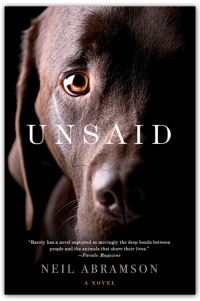
Unsaid: A Novel by Neil Abramson

Unsaid: A Novel
A husband laments the death of his wife; the deceased wife watches him suffer. Ugh. Just shoot me now. But really, it’s not as depressing as it sounds. In fact, it’s not depressing at all.

Unsaid tells a remarkable story of betrayal, forgiveness, animals, humans, and a variety of relationships, all seen through the eyes of a dead woman. The narrator, Helena, was a veterinarian and animal researcher until her early demise from cancer. Now, from some non-earthly realm, she observes those she left behind.

Her husband, David, a lawyer, torn apart by her death, must make peace with the animals she loved, as well as the secret parts of her life he discovers by chance. Unbeknownst to him, Helena had helped a colleague study whether or not a chimp can be taught to communicate using sign language. When the chimp’s life is endangered and crimes are committed, David is dragged into the situation, forcing him to make difficult choices and to come to terms with the truth about the woman he thought he knew so well.

The author, Neil Abramson, a lawyer married to a veterinarian, has created a cast of characters it’s easy to care about, including chimps, pigs, horses, dogs and cats. And even if you don’t think there’s any form of life after death, Abramson’s straightforward style makes a story narrated by a dead woman somehow feel believable, especially as Helena watches her husband struggle with the animals that were once her beloved companions.

In the face of [the horse] Arthur’s obstinacy, David starts tugging on the halter, cursing under his breath. Arthur doesn’t welcome my husband’s hostility. While David still holds the halter, Arthur whips his head around, sending David tumbling into the nearby hay bales.

When David rises unsteadily from the barn floor, he reminds me of Ray Bolger in The Wizard of Oz. His knee joints wobble and hay sticks out of his hair, topcoat, pant legs, and even his socks and shoes. When he walks, hay drops out of his pants as if the hay somehow has become his very essence.

Although a dead woman tells the story, is very much a tale about life, both how and how not to live it. Perhaps the true heart of the book is the nugget of wisdom conveyed to David by an old friend of his wife: Pessimism, cynicism and fear will only lead to a very small life. Don’t live small.

This review originally appeared in the bimonthly newspaper Happy Valley Animals.
Project Nim (2011) – Thoughtless Experiment Takes a Toll on Chimp and Humans

Project NimMovie Review: Project Nim (2011), available on DVD and HBO

This true tale of a hippy-dippy “science” project run amok will leave you queasy. From the woman who breast feeds a baby chimp, to the research director who sleeps with his assistants, no one in the documentary Project Nim, which chronicles a 1970s experiment to see if a chimp can learn sign language and then follows him through various travails, seems capable of establishing boundaries. In fact, so many social and scientific lines are crossed that the value of the experiment is highly questionable, at best.

After the six-week-old Nim is heartrendingly separated from his mother, he’s raised in a home with seven kids and hippie parents who share their pot with Nim, don’t know sign language, and have no concept of what a scientific experiment should include, such as record keeping or schedules. Although the rambunctious Nim seems happy there, playing with the kids and pets, he takes an intense dislike to the father of the family, to the point of biting him. This is only the first wedge that Nim drives between the people involved in the experiment.

Reminiscent of , the film is really about the conflicts among the humans in Nim’s life and the resulting toll those disagreements take on the animal. Arguments arise over where and how he’s taught, where he should live, and who should control him and the experiment. As Nim starts to behave more and more like a wild chimp, the decision is made to remove him from the home to be raised by a young woman whom Dr. Herbert Terrace, the project director, has the hots for.

Director James Marsh skillfully elicits from his interviewees the emotional impact of the project, including an account from one young researcher whose affair with Dr. Terrace ends abruptly and painfully. Many tears are shed by all involved, except the stone-faced doctor, but Nim’s first human mother sums up the project’s effect on Nim most aptly: “We made a commitment to him and we failed. We did a disservice to that soul.”

As the chimp grows older, he gets more aggressive, including tearing open the side of a woman’s face, and Dr. Terrace finally realizes the experiment must end. Nim is shipped off to a creepy medical research facility and then to an animal sanctuary, but it’s not clear which place is worse.

provides a fascinating look at the antics of the anything-goes ’70s and serves as a stark reminder that when humans put their emotional needs first, helpless creatures often pay a very high price. If the tale of Nim’s Dickensian life doesn’t leave you teary-eyed, you’re not a worthy primate.

This review originally appeared in the bimonthly newspaper Happy Valley Animals.